
Surprising fact to start: a large share of wallet compromises stem not from private-key leaks but from “blind signing” — approving transactions without understanding the exact token and fee movements. That observation reframes an ordinary question — should you install the Rabby Chrome extension? — as a technical risk-management problem, not merely a convenience choice. For DeFi power users in the US juggling multiple chains, NFTs, and composable positions, the right wallet reduces cognitive burden and attack surface; how it reduces those things is where value lies.
This article walks through how Rabby implements defensive mechanisms that matter in practice, how to download and use the Rabby Chrome extension without introducing new vulnerabilities, and which trade-offs you should accept or avoid. It focuses on mechanisms — transaction simulation, pre-transaction risk scanning, automatic network switching, and hardware-wallet integration — and translates them into operational practices you can reuse across wallets.
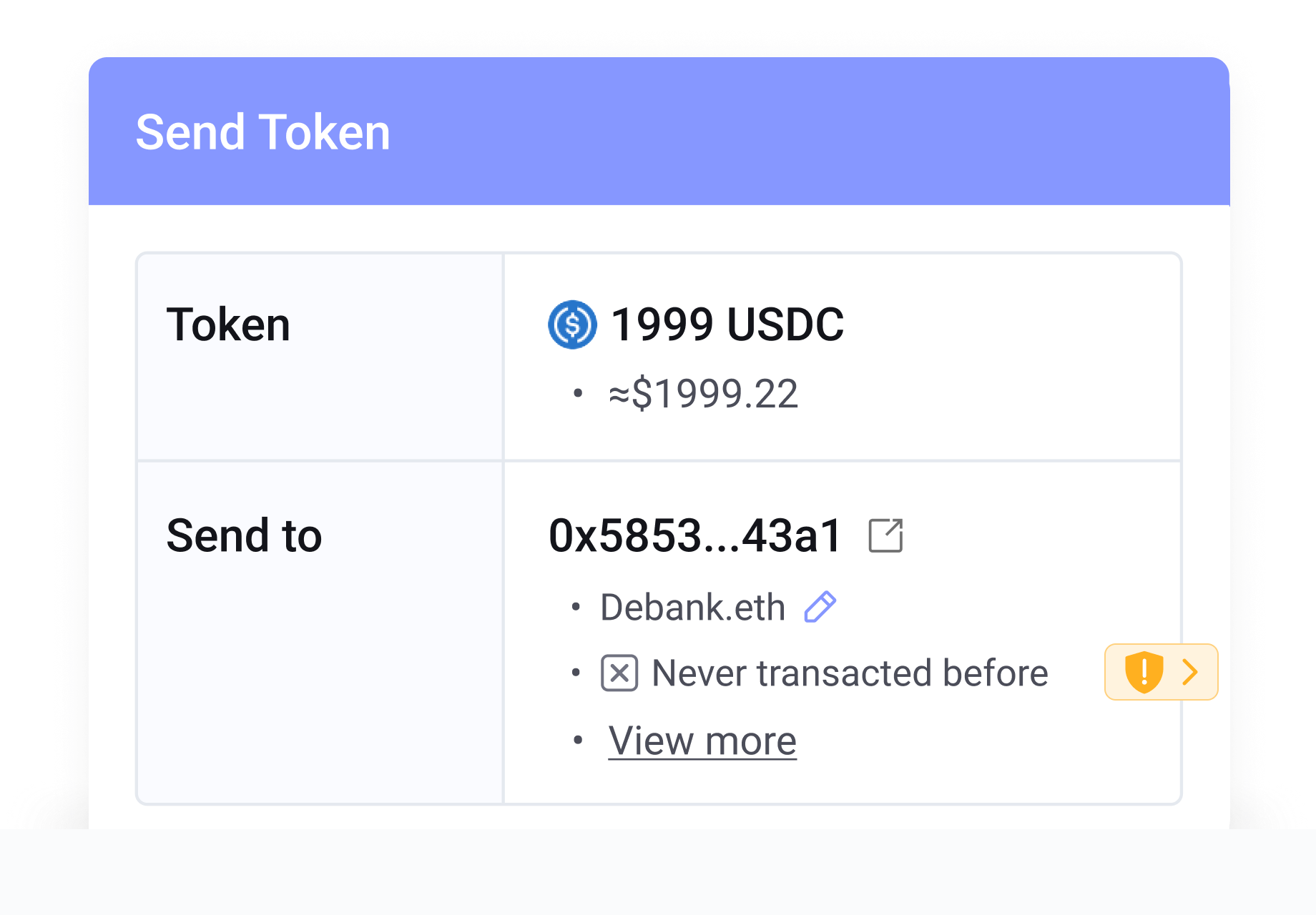
How Rabby’s defensive features work — mechanism first
Rabby is a non-custodial, multi-chain wallet built by DeBank and available as a browser extension for Chromium-based browsers (Chrome, Brave, Edge), mobile apps, and desktop clients for Windows and macOS. The architectural choice set matters because it determines attack surface: browser extensions interact directly with web pages (dApps), so careful UI and simulation layers are necessary to avoid blind signing and deceptive dApp prompts.
Three mechanisms set Rabby apart in day-to-day security for a DeFi power user:
– Transaction simulation: Before you sign, Rabby runs the transaction through a local simulation that estimates token balance deltas and gas costs. The simulation makes abstract blockchain operations concrete: instead of approving “0xABC… transfer,” you see “you will lose 1.23 USDC, receive 0 ETH, fee estimate 0.0021 ETH.” That reduced ambiguity is a direct countermeasure to phishing dApps that present misleading UI.
– Pre-transaction risk scanning: Rabby’s security engine flags patterns such as previously exploited contracts, suspicious approval requests (infinite approvals or approvals to unknown contracts), or malformed recipient addresses. This is a statistical and heuristic layer: it does not guarantee safety, but it raises red flags that typically require a human to pause and verify.
– Automatic network switching and cross-chain gas top-up: The wallet detects which chain a dApp intends to use and switches your active network automatically. Combined with a gas top-up feature, this prevents a common operational mistake: attempting a transaction on a chain where you lack gas and then performing risky workarounds. Automation reduces manual errors, but it also requires trust that the auto-switch logic is sane — and you should verify the target network before signing.
Installing the Rabby Chrome extension: safe steps and decision heuristics
Downloading a wallet extension is simple, but doing it safely requires discipline. Here is a compact operational checklist tailored to US DeFi users who value security and multi-chain functionality:
1) Source and signature: Install from the official extension store (Chromium Web Store) or the project’s verified distribution channel. Confirm the extension ID and publisher; Rabby is open-source (MIT license), so the code is auditable — that transparency reduces tail risk but does not eliminate it.
2) Seed generation and offline storage: Create a new wallet with the extension in a secure environment. Write the seed phrase on paper or a hardware-secure medium; never store it in cloud notes or email. If you import an existing seed, assume that any browser environment can be compromised and consider importing into a hardware wallet instead.
3) Hardware wallet pairing: For high-value accounts, pair Rabby with a Ledger, Trezor, Keystone, or another supported device. This moves signing keys off the host machine. In practice, using a hardware wallet with Rabby changes the trust boundary: you trust the extension’s UI for context but the device for final signature validation.
4) Test small: Before granting large approvals, simulate and sign a small interaction to confirm the flow. Rabby’s simulation display is a tool; use it to compare expected outcomes versus what the dApp UI shows. If the numbers diverge, pause and investigate.
Myth-busting: common misconceptions about ‘secure’ wallets
Misconception 1 — “Open-source means safe.” Open-source code increases transparency and allows audits, but it is not a guarantee. Vulnerabilities can still exist in implementation, build pipelines, or third-party dependencies. Rabby’s MIT license and public codebase are strong positives, but operational security (how you store seeds, browser hygiene, and hardware-wallet anchoring) remains decisive.
Misconception 2 — “Automatic features remove responsibility.” Automation like network switching and gas top-up reduces routine friction but introduces an implicit trust in the wallet’s logic. That trust is conditional: the tool helps when it works, but attackers exploit automation by tricking the wallet into switching to a malicious RPC endpoint or enticing a user to top up the wrong chain. Always scan the simulation output and recipient address before signing.
Misconception 3 — “Past incidents mean the project is unsafe.” Rabby had a Rabby Swap contract exploit in 2022 (~$190k loss), and the team froze the contract, compensated users, and tightened audits. That sequence shows both the risk and the remediation pathway: smart-contract ecosystems have residual risk, but proper response and improved auditing reduce repeat likelihood. Treat past incidents as signals to inspect response quality and follow-up fixes, not as binary pass/fail metrics.
Trade-offs and limitations — what Rabby does not solve
Rabby addresses many operational attack vectors, but it does not eliminate all risks. Two clear limitations affect decision-making:
– No built-in fiat on-ramp: You cannot buy crypto with a credit card inside Rabby. That design reduces regulatory friction and potential custodial risk exposure, but increases friction for new entrants. For US users who need fiat access, this means using a separate exchange or on-ramp and then transferring tokens into Rabby, which adds steps and monitoring requirements.
– No native staking inside the wallet: Rabby lacks in-wallet staking flows, so users must use external staking providers or dApps. This expands the attack surface and makes approval hygiene crucial, especially when granting staking contracts large token allowances.
Beyond those explicit limits, remember that no client can perfectly detect novel exploit patterns. Pre-transaction scanning flags known bad patterns; novel, custom exploits that look benign on heuristics will still pass. That residual blind spot is why layered defenses (hardware wallet, small test transactions, manual approval revocation) remain necessary.
Comparisons and composability: where Rabby fits in your toolset
Compared with MetaMask, Trust Wallet, or Coinbase Wallet, Rabby differentiates itself on simulation and automatic network switching. MetaMask is ubiquitous and well-integrated with many dApps; Coinbase Wallet and Trust Wallet are more consumer-oriented. Rabby is designed for DeFi power users who value explicit pre-signing visibility and institutional integrations (Gnosis Safe, Fireblocks). That means it’s suited both for advanced retail users and teams deploying multisig workflows.
One practical framework for deciding whether to add Rabby to your workflow:
– If you execute frequent cross-chain DeFi strategies and require fast context-aware signing, Rabby’s simulation and network automation are strong net benefits.
– If you rely on fiat on-ramps inside a single app, Rabby’s lack of on-ramp means you’ll retain a separate custodial exchange relationship.
– If you manage high-value assets, pair Rabby with a hardware wallet and institutional signing solutions to reduce browser-hosted key exposure.
Operational heuristics: a reusable checklist
Adopt these simple heuristics to reduce common causes of loss across any wallet, not just Rabby:
– Always read the simulation output line-by-line: token deltas, gas estimate, recipient address. If the simulation is absent or the numbers look odd, do not sign.
– Use hardware signing for high-value operations. Treat browser extensions as context providers and hardware devices as the ultimate gatekeepers.
– Revoke unused approvals periodically. Rabby’s built-in revocation tool makes this practical — treat it as routine maintenance, like changing passwords.
– Keep a separate “operational” account for routine dApp interactions and a cold/long-term account for large holdings.
What to watch next — conditional signals and scenarios
Two conditional scenarios matter for US DeFi users monitoring Rabby and the broader wallet landscape:
– If Rabby expands native fiat rails and staking, expect higher uptake among casual users but also a larger attack surface and new regulatory pressure. Monitor how the team plans to integrate third-party on-ramps and what custody assumptions those partners introduce.
– If cross-chain tooling continues to standardize (more reliable bridging primitives, richer multisig UX), Rabby’s multi-chain and gas-top-up features will grow more valuable for complex strategies. Conversely, if bridging remains fragmented, the operational complexity will keep advanced users relying on multiple specialized tools.
FAQ
How do I safely download the Rabby Chrome extension?
Install from the Chromium Web Store or the project’s verified distribution, verify the publisher, and confirm the extension ID. Create or import your wallet in a secure environment, and if possible, immediately pair a hardware wallet. Use a small test transaction first to verify the UX and simulation outputs.
Does Rabby prevent all smart contract exploits?
No. Rabby’s simulation and risk scanning reduce the chance of blind-signing and known bad patterns, but they cannot guarantee detection of novel or logic-level contract vulnerabilities. Use layered defenses: hardware signing, limited approvals, and routine approval revocation.
Can I import my MetaMask wallet into Rabby?
Yes — Rabby allows importing wallets via seed phrase or private key and includes a ‘Flip’ toggle to switch default behavior between Rabby and MetaMask. For high-value accounts, prefer importing only in read-only mode and then connecting via hardware wallet for signing.
Is Rabby a good choice for institutional use?
Rabby integrates with multi-sig and enterprise tools like Gnosis Safe and Fireblocks, which makes it appropriate as part of an institutional stack. For institutional deployments, pair it with enterprise custody solutions and formal operational procedures.
For a practical next step, if you want to review the project details and official distribution channels before installing, the project’s official page is a good landing spot: rabby wallet. The central lesson is this: choose wallets that convert abstract blockchain calls into concrete, human-verifiable outcomes, and then harden the rest of your operational perimeter with hardware signing, approval hygiene, and routine audits of your own behavior.